Hericenones and the Nerve Growth Factor Connection in Lion’s Mane Mushroom
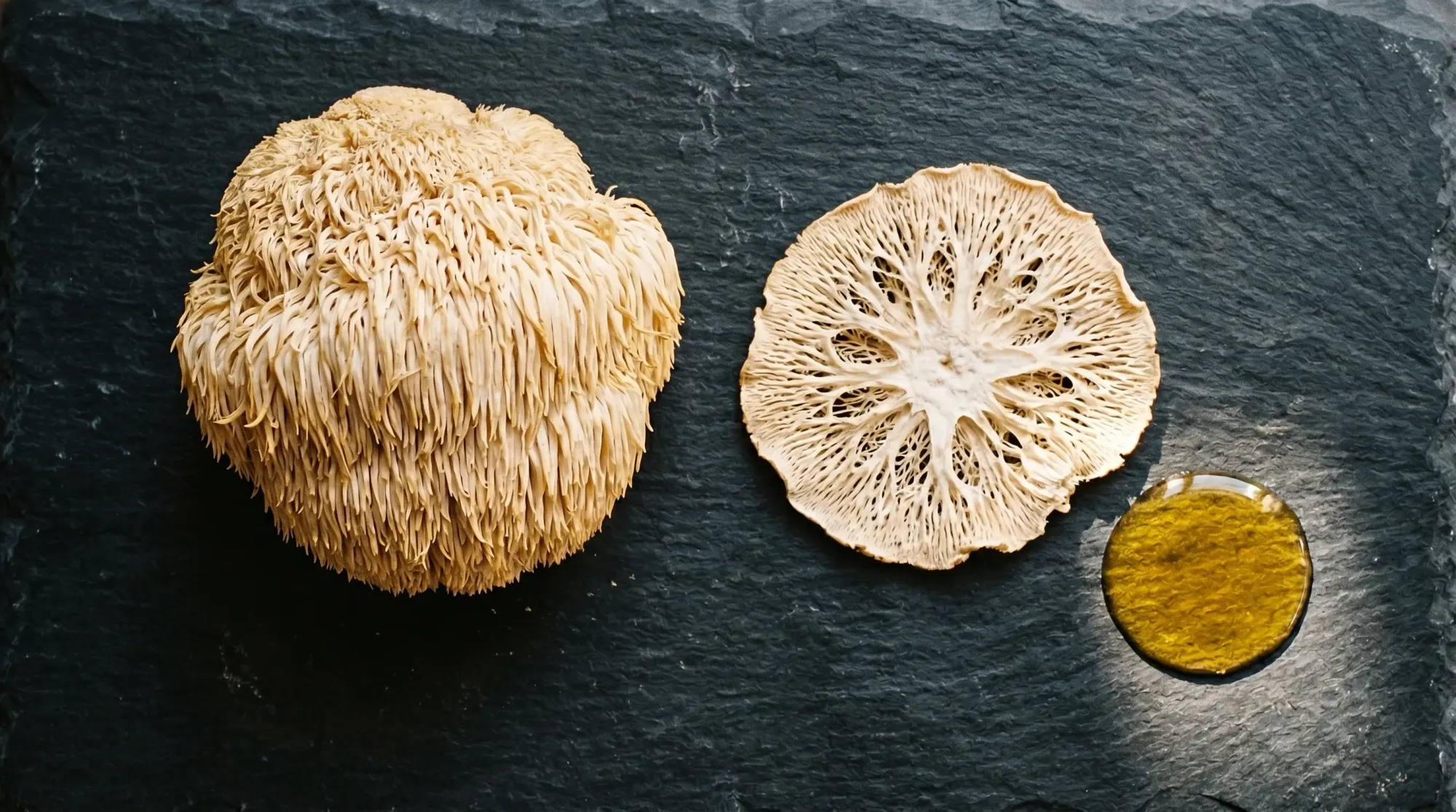
— HOOK —
The reason Lion's Mane is linked to brain health is a single mechanism: stimulation of NGF synthesis. And behind that mechanism are two families of compounds.
One in the fruiting body, one in the mycelium.
The subject of this article is the one in the fruiting body: Hericenon.
— WHAT IS HERICENON? —
Hericenon is a family of diterpenoids isolated from the fruiting body of Hericium erinaceus (Lion's Mane). It was discovered in 1991 by the Japanese researcher Hirokazu Kawagishi and his team.
Multiple variants, from Hericenon A to H, have been identified to date. Among them, Hericenon C, D, and E are the most extensively studied.
Reference: Kawagishi, H. et al. (1991). Hericenones C, D and E, stimulators of nerve growth factor (NGF)-synthesis, from the mushroom Hericium erinaceus. Tetrahedron Letters, 32(35).
— THE NGF CONNECTION —
NGF (Nerve Growth Factor) is a protein critical for the survival, growth, and repair of neurons. When NGF synthesis declines in the adult brain, neuroplasticity drops — forming new synaptic connections becomes more difficult.
What makes the discovery of hericenones special: although they are small enough molecules to cross the blood-brain barrier, they stimulate NGF synthesis indirectly.
Mechanism: Hericenon is not NGF itself. It does not enter the brain and grow nerve cells directly. Instead, it stimulates astrocyte cells, triggering the production of endogenous NGF. In other words, it helps the body produce its own NGF.
This mechanism matters because externally administered NGF cannot cross the blood-brain barrier. Hericenon, however, crosses the barrier and initiates NGF production from the inside.
— HERICENON vs ERINACINE —
Lion's Mane possesses two families of NGF-stimulating compounds:
Hericenon: Found in the fruiting body. It has a diterpenoid structure. Discovered by Kawagishi (1991).
Erinacine: Found in the mycelium (the root-like structure). It also has a diterpenoid framework, but with a different chemical skeleton. Discovered by Kawagishi (1994).
Both stimulate NGF synthesis, but they originate from different sources. Because MYCOVITA Lion's Mane product is manufactured from 100% fruiting body, it contains Hericenon. Mycelium-based products, on the other hand, contain Erinacine.
Both compound families have been shown to stimulate NGF synthesis in vitro. A definitive clinical comparison of which is more effective has not yet been conducted.
— RESEARCH —
In vitro: In the 1991 study by Kawagishi and his team, Hericenon C and D were reported to significantly increase NGF synthesis in astrocyte cell culture.
Animal model: In a 2009 study by Mori and colleagues, Lion's Mane supplementation was reported to alter cognitive functions in aged mice. The effect has been suggested to be linked to the synergistic action of hericenones and erinacines.
Human study: In a 2009 double-blind, placebo-controlled study by Mori et al., elderly participants with mild cognitive impairment showed changes in cognitive test scores after supplementing with Lion's Mane. When supplementation ceased, the scores declined.
Reference: Mori, K. et al. (2009). Improving effects of the mushroom Yamabushitake on mild cognitive impairment. Phytotherapy Research, 23(3).
Candid assessment: The existing evidence is promising but limited. Large-scale, multicenter clinical trials have not yet been completed. It is also not yet possible to distinguish the isolated effect of hericenones from that of the whole fruiting body.
— BIOAVAILABILITY —
Hericenon is a fat-soluble (lipophilic) compound. This means its absorption increases in the presence of fat.
Practical implication: taking Lion's Mane powder not with water alone but with a fat-containing carrier (coconut milk, MCT oil, buttered coffee) can potentially enhance bioavailability.
The chitin cell wall also comes into play here: hot water extraction partially opens the chitin barrier and facilitates the release of hericenones. For this reason, taking Lion's Mane powder with a hot liquid (70–80°C) is preferred.
— SCIENTIFIC REFERENCES —
Kawagishi, H. et al. (1991). Hericenones C, D and E, stimulators of nerve growth factor synthesis. Tetrahedron Letters, 32(35), 4561-4564.
Kawagishi, H. et al. (1994). Erinacines A, B and C, strong stimulators of nerve growth factor synthesis. Tetrahedron Letters, 35(10), 1569-1572.
Mori, K. et al. (2009). Improving effects of the mushroom Yamabushitake on mild cognitive impairment. Phytotherapy Research, 23(3), 367-372.
Lai, P.L. et al. (2013). Neurotrophic properties of the Lion's mane medicinal mushroom. International Journal of Medicinal Mushrooms, 15(6).
You Might Be Interested In
→ What Is NGF? — Nerve Growth Factor
→ MIND | Lion's Mane — Species Encyclopedia
→ The Gut-Brain Axis and Lion's Mane
→ What Is Chitin? — The Invisible Shield of Mushrooms
→ 30-Day Lion's Mane Experience
NGF Axis — Related Resources
A structured content cluster on the Lion's Mane neurotrophic pathway:
- Lion's Mane Species Encyclopedia — The complete profile of the species.
- Hericenon — NGF synthesis stimulators in the fruiting body.
- Erinacine — The form in the mycelium that can cross the blood-brain barrier.
- NGF — The biological role of nerve growth factor.
- The Gut-Brain Axis — Enteric nervous system interaction.
- 30-Day Profile — Timeline of the neurotrophic process.
- Nootropic Stack — Combination assessment with other compounds.
Related Reading
- What Is Erinacine and Its Role in Lion's Mane Mycelium — What Is Erinacine and Its Role in Lion's Mane Mycelium
- Lion's Mane (Hericium erinaceus) Species Encyclopedia — Lion's Mane (Hericium erinaceus) Species Encyclopedia
- Lion's Mane 30-Day Usage Profile: Neurotrophic Process Timeline — Neurotrophic Process Timeline
This content is for informational purposes only and does not constitute medical advice. Consult your physician before making any health decisions. Functional mushrooms are not drugs and cannot be used to treat diseases.
Version: 1.0 | Last updated: 20 Apr 2026 | Number of sources reviewed: 9+ | Method: Editorial Policy | References: Bibliography