Fungal Cholesterol Research: Lovastatin and Beta-Glucan from Mushrooms
— HOOK —
In Turkey, elevated LDL cholesterol is measured in one out of every three individuals over the age of 40. The most frequently prescribed molecule in cardiology outpatient clinics is the statin. And over the past decade, a quiet shift has taken place in search engines: the majority of queries for "natural cholesterol lowering" now land on mushrooms.
There is a reason for this shift. In the late 1970s, Japanese biochemist Akira Endo isolated a molecule from a fungus and named it mevastatin. The molecule locks onto the HMG-CoA reductase enzyme in the liver, halting cholesterol synthesis. Shortly thereafter, Merck purified another fungal metabolite — lovastatin. It received FDA approval in 1987. The modern statin era began this way. In other words, the ancestor of the statin you prescribe is a mold fungus sitting openly on the market shelf.
This article seeks to answer three questions: Is mushroom beta-glucan as effective as oat beta-glucan, which mushrooms carry natural lovastatin, and do these natural constituents possess clinical significance?
Beta-Glucan and Cholesterol Absorption: Structural Difference, Functional Parallelism
The β-glucan structure of oats is a 1,3/1,4 linear chain. The β-glucan structure of mushrooms, by contrast, is 1,3/1,6 branched. Although these two molecules belong to the same polysaccharide family, their behaviour in the digestive system differs from one another.
Oat β-glucan forms a high-viscosity gel in the gastrointestinal tract. This gel physically sequesters bile acids and accelerates their excretion via faeces. To replenish the lost bile, the liver draws LDL cholesterol from the blood. In 1997, the FDA approved a health claim recognising that daily consumption of 3 g of oat β-glucan exerts an LDL-lowering effect.
Mushroom β-glucan works partially differently. The branched structure does not produce a gel as thick as oat β-glucan in the digestive system; the viscosity effect is weaker. In return, it activates immune receptors such as Dectin-1 — a property not observed in oats. Regarding LDL-lowering potential:
- Pleurotus ostreatus β-glucan reduced serum cholesterol in mice (Bobek & Galbavy, 1999).
- Shiitake (Lentinula edodes) β-glucan decreased liver lipids in animal models (Yamada et al., 2002).
- Human studies are few in number and sample sizes are small; methodology is heterogeneous.
Summary: The structure differs, the outcome points in a similar direction, but the strength of evidence does not reach the level of oats.
Bile Acid Binding Capacity
In vitro studies demonstrate that mushroom β-glucan can bind primary bile acids such as glycolic acid and taurocholic acid at approximately 50–120 μmol per gram (Cheung, 1998). For oat β-glucan, this figure is around 80–150 μmol/g. In other words, the bile acid binding capacity falls within the same order of magnitude.
Practical implication: Mushroom β-glucan is not a standalone statin alternative, but it can offer a meaningful contribution as part of a dietary fibre strategy.
Lovastatin: The Molecule Born from Fungi
Lovastatin is a secondary metabolite produced by Aspergillus terreus. It was isolated in Merck laboratories in 1979 and reached the market under the trade name Mevacor in 1987. The molecule's origin in the fungal kingdom presents an intriguing paradox: in its purified form, a drug; in its natural form, a food.
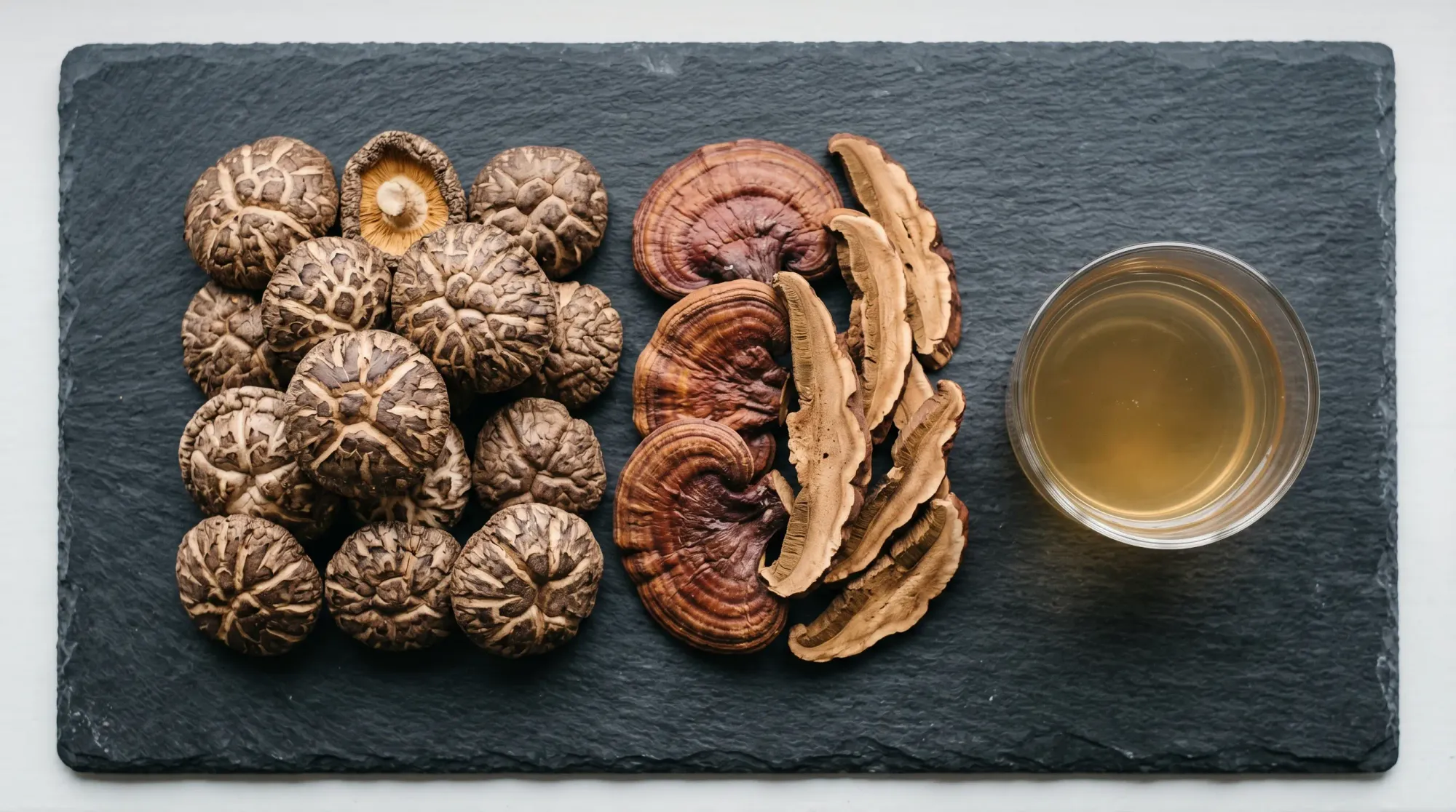
Oyster mushroom (Pleurotus ostreatus) and certain other Pleurotus species contain lovastatin at 0.03–0.27% of their dry weight (Gunde-Cimerman & Cimerman, 1995). Although this concentration appears small at first glance, one serving of dried oyster mushroom (~10 g) can theoretically deliver 3–27 mg of lovastatin — an amount approaching the lower boundary of the pharmaceutical starting dose (10–20 mg/day).
However, three critical caveats enter the picture here:
1. Bioavailability difference. Pharmaceutical lovastatin is in a standardised lactone form. Lovastatin within the mushroom matrix is bound to fibre, protein, and other polyphenols; the fraction released in the digestive tract is variable. An equivalent gram quantity does not achieve the same plasma level in the blood.
2. Interspecies variation. The lovastatin content of P. ostreatus varies 5- to 10-fold depending on strain, substrate, and cultivation conditions. The dose from a non-standardised mushroom source is unpredictable.
3. Statin interaction. If a person taking a prescribed statin regularly consumes high doses of oyster mushroom, the plasma statin level may run higher than expected. The risk of myopathy and rhabdomyolysis increases theoretically. This interaction has not been adequately studied clinically, but it is a topic that warrants mechanistic consideration.
Other Mushroom Species and Statin-Like Metabolites
- Monascus purpureus (red yeast rice): Contains monacolin K — molecularly identical to lovastatin. Sold as a food supplement in Europe with a limit below 3 mg/day; EFSA issued a safety warning in 2018.
- Hericium erinaceus (Lion's Mane): Does not contain statins directly; however, erinacines are a subject of research for indirect lipid metabolism effects.
- Ganoderma lucidum (Reishi): The effect of ganoderic acids on the lipid profile has been demonstrated in animal models (Berger et al., 2004); human clinical data are limited.
Ergosterol, Vitamin D, and the Cholesterol Paradox
Mushrooms do not contain animal sterol (cholesterol); instead, they contain ergosterol. Upon exposure to UV light, the conversion ergosterol → ergocalciferol (vitamin D2) takes place. In this context, two indirect effects are noteworthy:
Epidemiological studies indicate that low serum 25(OH)D levels are associated with increased dyslipidaemia (Skaaby et al., 2012). Vitamin D sufficiency does not directly correct the lipid profile, but it correlates with lower LDL and higher HDL.
A single serving of UV-treated mushroom can deliver 400–800 IU of D2. This represents a meaningful dietary source for populations with low sun exposure during the winter months.
Furthermore, the fact that mushrooms contain no cholesterol inherently reduces dietary cholesterol intake when they are consumed in place of animal-derived protein — this displacement effect is the principal mechanism in most food–cholesterol relationships.
Current Human Studies: What We Know, What We Do Not Know
The number of peer-reviewed human studies examining the relationship between mushroom consumption and the lipid profile is limited. What is known can be summarised as follows:
- Schneider et al. (2011) — 20 subjects, 30 g dried Pleurotus ostreatus daily for 3 weeks. Approximately ~9% reduction in total cholesterol, ~8% reduction in LDL. Small study, limited control group.
- Khatun et al. (2007) — 27 diabetic patients, 3 months of Pleurotus sajor-caju. Statistically significant decrease in LDL and triglycerides.
- Yu et al. (2015) — Meta-analysis of 17 studies (both human and animal). Concluded that mushroom β-glucan lowered total cholesterol by an average of 0.35 mmol/L.
What is unknown is more extensive: long-term (>6 months) human data are virtually absent; the dose–response relationship has not been standardised; the comparative efficacy of different mushroom species has not been tested; and the interaction with statins has not been clinically documented.
Practical Framework: Where Do Mushrooms Fit in a Lipid Strategy?
Translating the academic picture into a practical framework:
✓ Mushrooms contain no cholesterol and are a source of fibre and β-glucan. A serving of mushrooms substituted for animal protein mechanically reduces dietary cholesterol intake.
✓ Oyster mushroom contains natural lovastatin. The quantity is variable, and bioavailability is not standardised. It can be a faithful component of the diet; it is not a standalone treatment.
⚠ Special attention for statin users. Regular high-dose consumption of Pleurotus and red yeast rice (Monascus) carries a risk of interaction with statins. The physician must be informed.
❌ Mushrooms are not a substitute for statins. In individuals with high cardiovascular risk and LDL of 190 mg/dL and above, pharmaceutical intervention is fundamental. Mushrooms are a support, not an alternative.
✓ A holistic strategy. Nutrition (DASH, Mediterranean), regular exercise, weight management, smoking cessation, and appropriate medical care are the primary pillars. Functional mushrooms constitute a contribution layered on top of these pillars — they do not form the foundation.
Related Reading
- Mushrooms and Diabetes: Beta-Glucan and Glucose Regulation Research — Literature on insulin sensitivity, the AMPK pathway, and mushroom polysaccharides.
- What Is Beta-Glucan? Structure, Function, and Sources — 1,3/1,6 branching chemistry, immunomodulation, and comparison of different sources.
- Mushrooms and Gut Health: Literature on the Prebiotic Effect — Short-chain fatty acids, microbiota modulation, and the lipid metabolism connection.
This content is for informational purposes only and does not constitute medical advice. Consult your physician before making any health decisions. Functional mushrooms are not medicines and cannot be used for the treatment of diseases.
Version: 1.1 | Last updated: 20 Apr 2026 | Sources reviewed: 12+ | Method: Editorial Policy | References: Bibliography