Does Cordyceps Actually Work? A Scientific Evaluation
— THE HOOK —
This question arrives frequently. And it deserves an honest answer.
Yes — but understanding how it works allows you to calibrate your expectations correctly. Cordyceps does not operate like caffeine. And that is not a shortcoming; it is precisely the opposite.
— ORIGIN STORY —
Stuttgart. 1993. World Athletics Championships.
The Chinese women's national team shattered world records in succession across the 1,500 m, 3,000 m, and 10,000 m events. The performance gains were so dramatic that whispers of suspicion rippled through the stands. The athletes were taken for doping control. They came back clean.
Coach Ma Junren offered a single answer to the barrage of questions: intense training, turtle blood, and a mountain mushroom.
That mushroom was Cordyceps. The news spread globally. Sports physiology laboratories queued up for investigations. And Cordyceps has not left the research agenda since that day.
Yet a truth lingers in the shadow of that story: the Stuttgart records alone do not constitute proof for Cordyceps. The evidence has been accumulating in laboratories.
— CAFFEINE OR CORDYCEPIN —
When the subject is energy, two fundamentally different mechanisms are at play.
Caffeine: Blocks adenosine receptors. It sends a "not tired" signal to the brain. It does not generate real energy — it masks the perception of fatigue. When the effect subsides, accumulated adenosine floods in — the crash.
Cordycepin: A modified form of the adenosine nucleoside. It operates at the mitochondrial level — supporting oxygen utilization efficiency and ATP production. It does not manipulate the nervous system. No palpitations, no crash.
The distinction is this: caffeine borrows existing energy. Cordycepin supports energy production capacity.
Reference: Tuli, H.S. et al. (2014). Biological importance of Cordyceps species. Journal of Biological Research.
— THE RESEARCH —
Exercise Performance: A double-blind study conducted in healthy adults reported that a blend supplement containing C. militaris increased VO₂max and time to exhaustion during exercise compared to placebo.
Reference: Dudgeon, W.D. et al. (2018). Journal of the International Society of Sports Nutrition.
Anti-Fatigue: In mouse models, C. militaris polysaccharides increased swimming endurance and reduced blood lactate levels.
Reference: Song, J. et al. (2015). International Journal of Biological Macromolecules, 76, 169-175.
Mitochondrial Effect: Increased mitochondrial respiratory chain activity and optimization of cellular ATP production were reported in mouse models.
Reference: Chen, S. et al. (2010). Journal of Medicinal Food.
Limitations: Human clinical studies remain limited in number. The majority of existing studies are animal models or in vitro investigations. Larger randomized controlled human trials are needed — this is an honest picture.
— C. SINENSIS OR C. MILITARIS —
Two names circulate in the marketplace. They are often used interchangeably — incorrectly.
C. sinensis: Grows as a parasite on specific insect larvae in the Himalayan highlands. Controlled cultivation is nearly impossible. The per-kilogram price exceeds that of gold. The vast majority of inexpensive products sold under the "sinensis" label are either counterfeit or liquid-tank mycelium — not fruiting bodies.
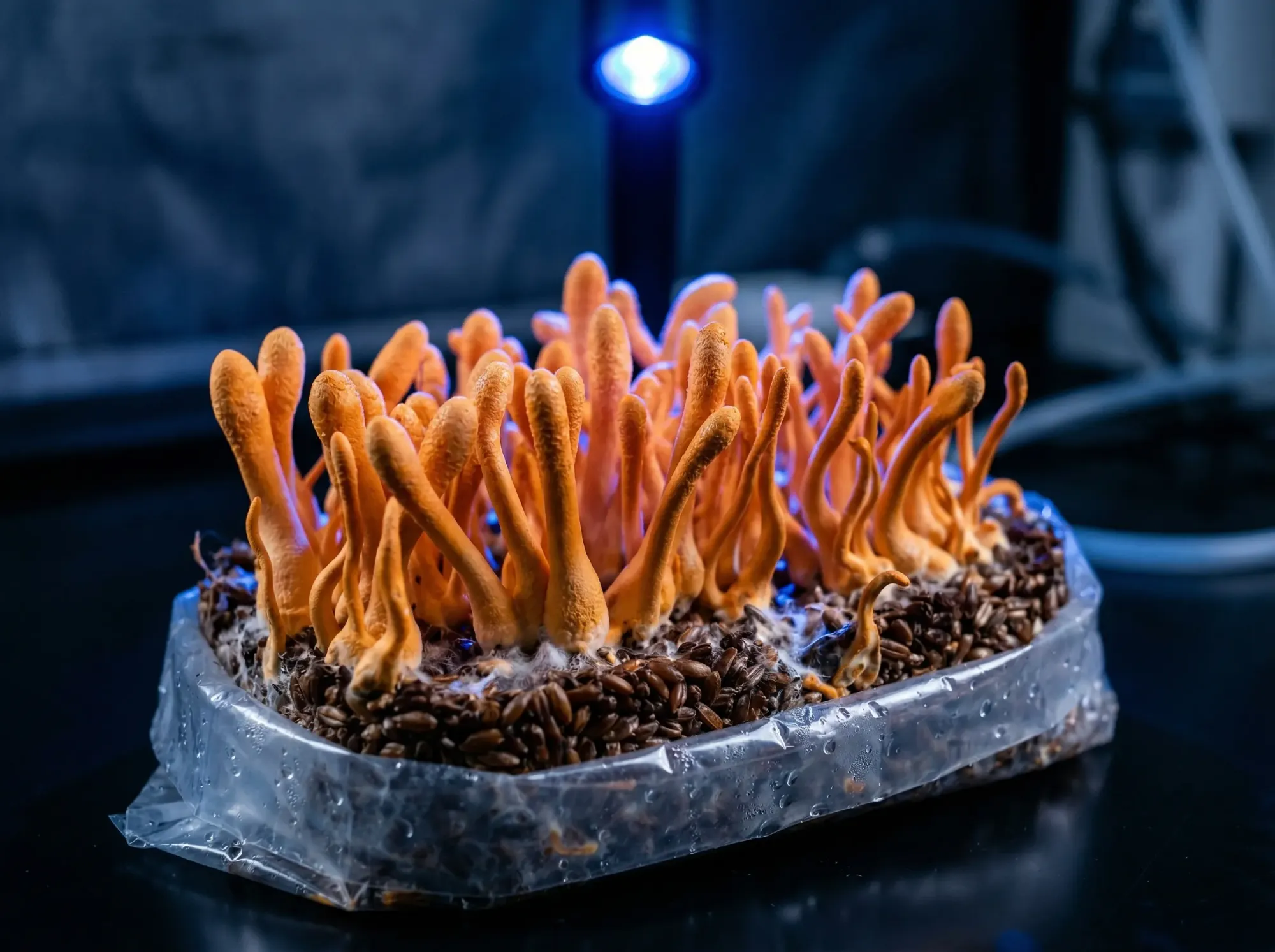
C. militaris: Can be cultivated on grain-based substrate under controlled conditions. The bulk of scientific research is conducted on this species. And the critical finding: cordycepin concentration in C. militaris is generally markedly higher than in C. sinensis — controlled production optimizes compound accumulation.
Reference: Tuli, H.S. et al. (2014). 3 Biotech, 4(1), 1-12.
— MYCOVITA CORDYCEPS —
The most sensitive species in the MYCOVITA portfolio. Every 3–4 cycles, a fresh strain arrives from Netherlands-certified facilities — this is how we manage degeneration risk. When the strain degrades, color fades and cordycepin drops. The orange-amber hue is the visual indicator of cordycepin synthesis.
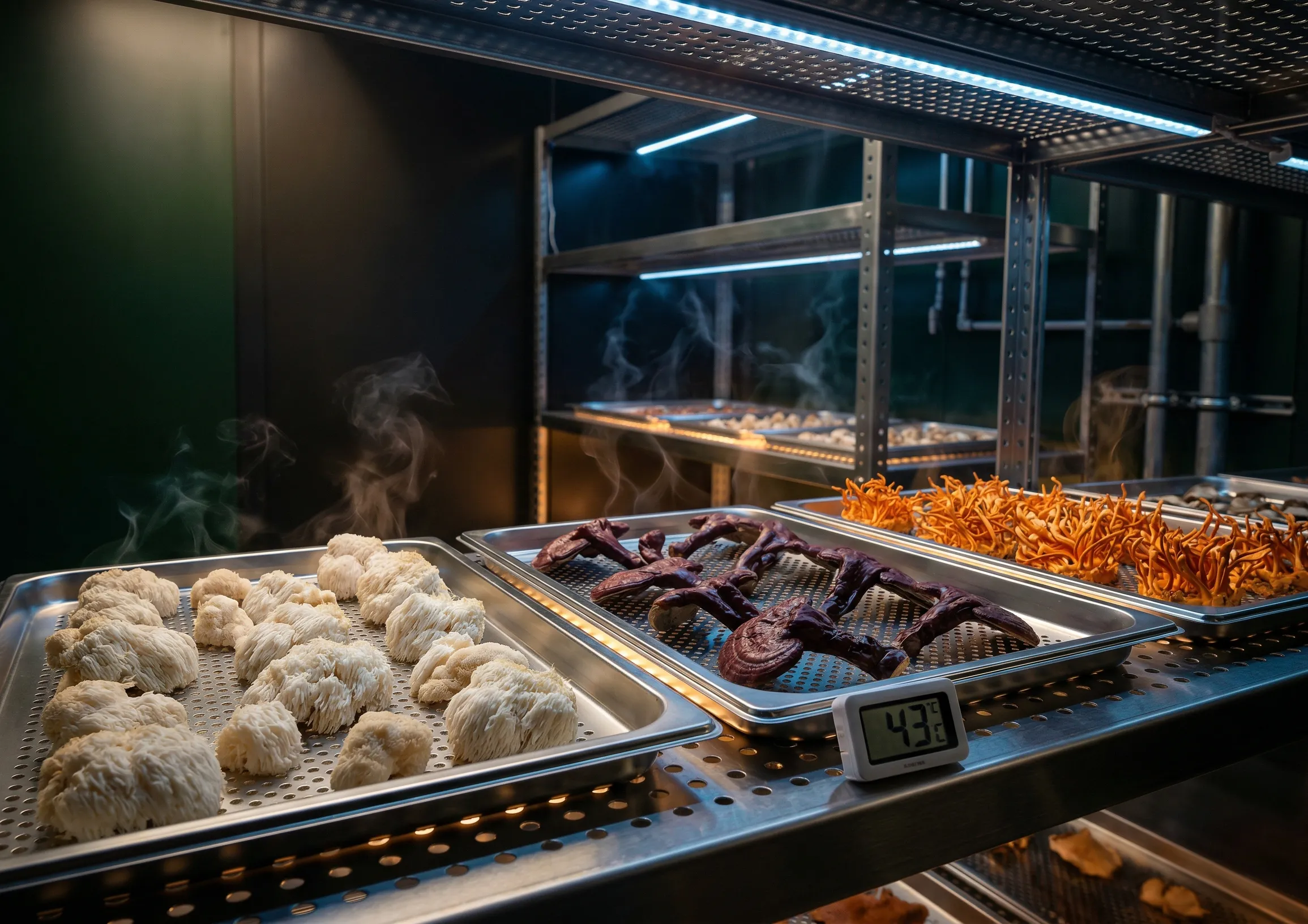
Drying: constant 40°C — the lowest temperature in the portfolio. Required because of cordycepin's heat sensitivity.
Every batch carries a COA. Cordycepin content is analyzed and documented.
— WHAT TO EXPECT —
Noticeable effect: Cordyceps' energy effect can be felt within 1–3 days — faster than other species.
Cumulative effect: Mitochondrial adaptation develops over time. Consistent use over 4–6 weeks produces a more pronounced difference.
What not to expect: A sudden energy spike like caffeine. Cordyceps does not work that way — and this is not a deficiency. There is no crash either.
Training protocol: 45–60 minutes beforehand. This is the timing window researchers recommend so that cordycepin's mitochondrial effect aligns with the training session.
— CAUTION —
Individuals using blood thinners should consult their physician. Exercise caution prior to surgical procedures.
Related reading: Cordyceps Encyclopedia · What Is Cordycepin? · Athlete-Specific Protocol
MYCOVITA's production philosophy and transparency principles: Why MYCOVITA?
Mycelial Library | MYCOVITA
You May Also Find Interesting
→ Travel Protocol — How to Use While Traveling
→ Can Mushrooms Produced in Turkey Be Trusted?
This content is for informational purposes only and does not constitute medical advice. Consult your physician before making any health decisions. Functional mushrooms are not pharmaceuticals and cannot be used to treat diseases.
Version: 1.0 | Last updated: 20 Apr 2026 | Sources reviewed: 9+ | Methodology: Editorial Policy | References: Bibliography