Chitin and Its Structural Role in the Fungal Cell Wall
— THE CHALLENGE —
You take a mushroom powder. You stir it into your coffee. You drink it. But how much of what you ingested actually reaches your body?
The answer may be less than you think. Because the bioactive compounds of mushrooms — beta-glucans, triterpenes, hericenones, cordycepin — are locked inside the cell wall. And this wall is made of a material that the human digestive system cannot break down on its own: chitin.
— WHAT IS CHITIN —
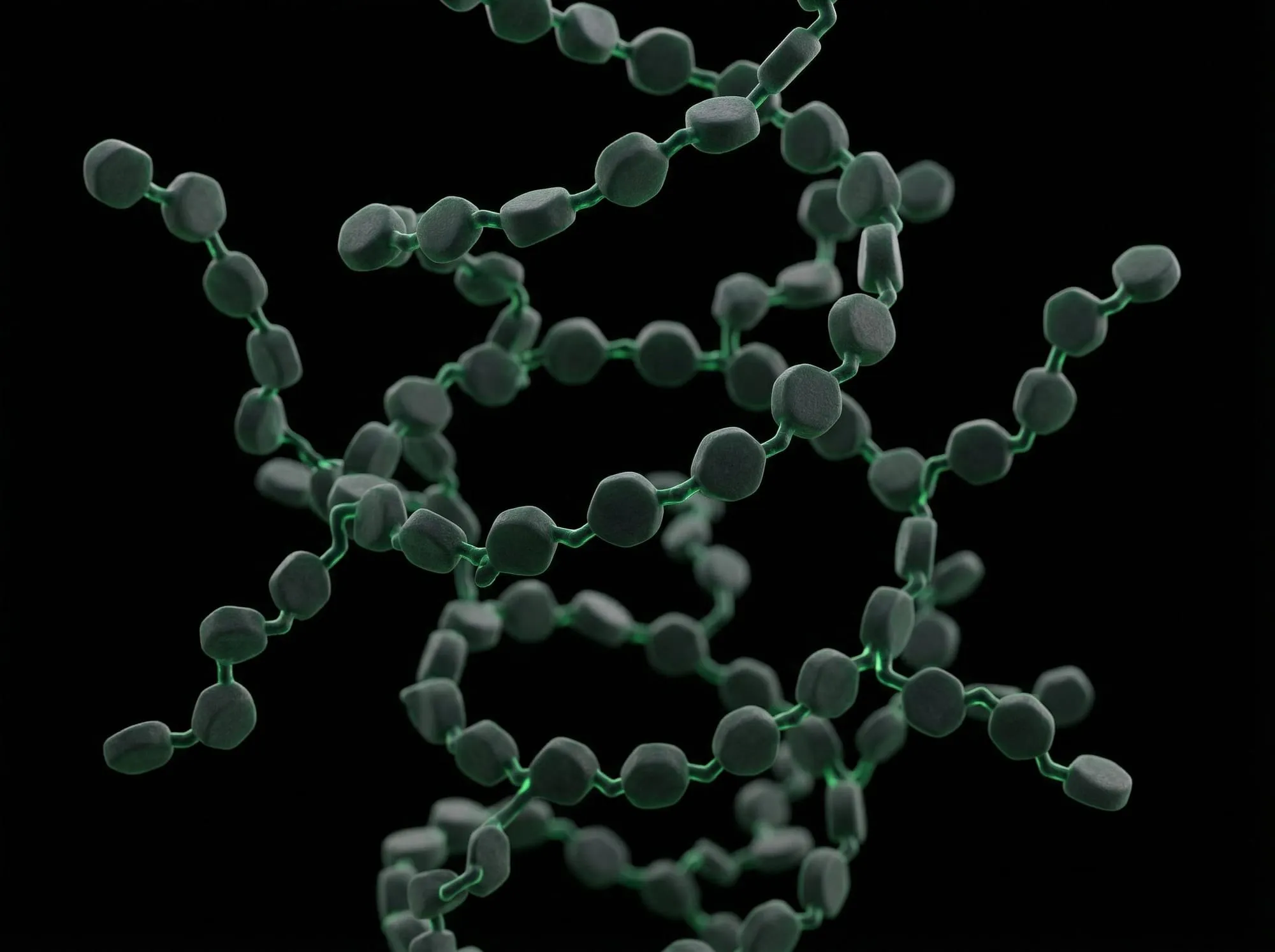
Chitin (C₈H₁₃NO₅)n — one of nature’s most abundant biopolymers. It is found in insect exoskeletons, crustaceans, mollusks, and the cell walls of fungi.
Chemically, it resembles cellulose — long, linear polysaccharide chains — but with a key difference: acetamido groups. These groups form strong hydrogen bonds that link chitin chains together. The result: an extremely durable, mechanically robust, chemically resistant structure.
The human body produces the enzyme chitinase, but the quantity is insufficient to effectively degrade the fungal cell wall. Especially when consuming raw or minimally processed mushrooms, a large portion of chitin is excreted undigested.
— WHY IT MATTERS —
The valuable compounds of mushrooms — beta-glucans, triterpenes, polysaccharide-protein complexes — reside inside or associated with the cell wall. Without breaking the chitin wall, these compounds cannot diffuse into water or digestive fluids.
This simple fact reveals the fundamental problem of the entire mushroom powder market: drying and grinding are not enough. Grinding reduces particle size but does not break the chitin structure. Millions of micron-sized chitin particles pass through the digestive system and are excreted without releasing their contents.
Therefore, extraction — breaking the chitin wall — is the single most important process determining quality in functional mushroom products.
— BREAKING CHITIN: METHODS —
Hot water extraction: The most common and traditional method. Long steeping or boiling in water at 80–100°C allows water-soluble beta-glucans and polysaccharides to emerge from the chitin wall. The Japanese traditions of Reishi tea and Shiitake dashi are based on this principle.
Ultrasonic extraction: High-frequency sound waves generate microscopic bubbles in the liquid (cavitation). When these bubbles collapse, they create localized extreme pressure and temperature — mechanically fracturing the chitin wall. It preserves heat-sensitive compounds because the bulk liquid temperature remains low.
Alcohol extraction: Compounds insoluble in water — especially triterpenes (Reishi’s ganoderic acids) — require ethanol-based extraction. For this reason, full-spectrum products often employ dual extraction: hot water first, then alcohol.
Enzymatic degradation: Biological breakdown using chitinase and glucanase enzymes. The slowest but most gentle method.
— INFUSION GRADE AND CHITIN —
MYCOVITA Apothecary Series is presented in ‘Demlik Kesim | Infusion Grade’ format. This format — a homogenous grind approaching the fineness of coffee grounds — is optimized for hot water extraction.
Principle: Fine grinding maximizes contact surface area. Hot water (70–90°C, depending on the species) penetrates these fine particles over 5–15 minutes. The chitin wall loosens through thermal expansion, allowing water-soluble compounds to diffuse into the liquid.
How this process differs from swallowing a capsule or mixing with cold water: A capsule dissolves in digestive fluid at 37°C — a temperature insufficient to break the chitin wall. Cold water extraction, in turn, remains below the solubility threshold of beta-glucans.
Related reading: What Is Beta-Glucan? · Mycelium vs. Fruiting Body · What Is Substrate? · Brewing Guide
MYCOVITA’s production philosophy and transparency principles: Why MYCOVITA?
— SCIENTIFIC REFERENCES —
Rinaudo, M. (2006). Chitin and chitosan: Properties and applications. Progress in Polymer Science, 31(7), 603-632.
Cheung, P.C.K. (2010). The nutritional and health benefits of mushrooms. Nutrition Bulletin, 35(4), 292-299.
Zhang, M. et al. (2007). Antitumor polysaccharides from mushrooms: a review on their isolation process, structural characteristics and antitumor activity. Trends in Food Science & Technology, 18(1), 4-19.
You May Also Like
→ Mushroom Science Glossary — 130+ Terms from A to Z
→ Can Mushrooms Produced in Turkey Be Trusted?
→ Functional Mushroom Production in Turkey
→ Mushroom Powder or Capsules?
Beta-Glucan and Immunomodulation — Related Resources
A content cluster on mushroom beta-glucan and immune system interaction:
- What Is Beta-Glucan? — Molecular structure and linkage types.
- How the Immune System Works — Dectin-1 receptor and innate immunity.
- Beta-Glucan Measurement Methods — Megazyme and other laboratory methods.
- Lentinan — Shiitake’s approved beta-glucan.
- PSK — Turkey Tail’s polysaccharide-protein complex.
- D-Fraction — Maitake’s active beta-glucan fraction.
- Lentinan vs PSK vs Beta-Glucan — Comparison.
- Sparassis crispa — The highest natural beta-glucan density.
- Chitin — The cell wall that traps beta-glucan.
- Extraction Methods — Beta-glucan bioavailability.
This content is for informational purposes only and does not constitute medical advice. Consult your physician before making any health decisions. Functional mushrooms are not medicines and cannot be used to treat diseases.
Version: 1.0 | Last updated: 20 Apr 2026 | Sources reviewed: 6+ | Method: Editorial Policy | References: Bibliography