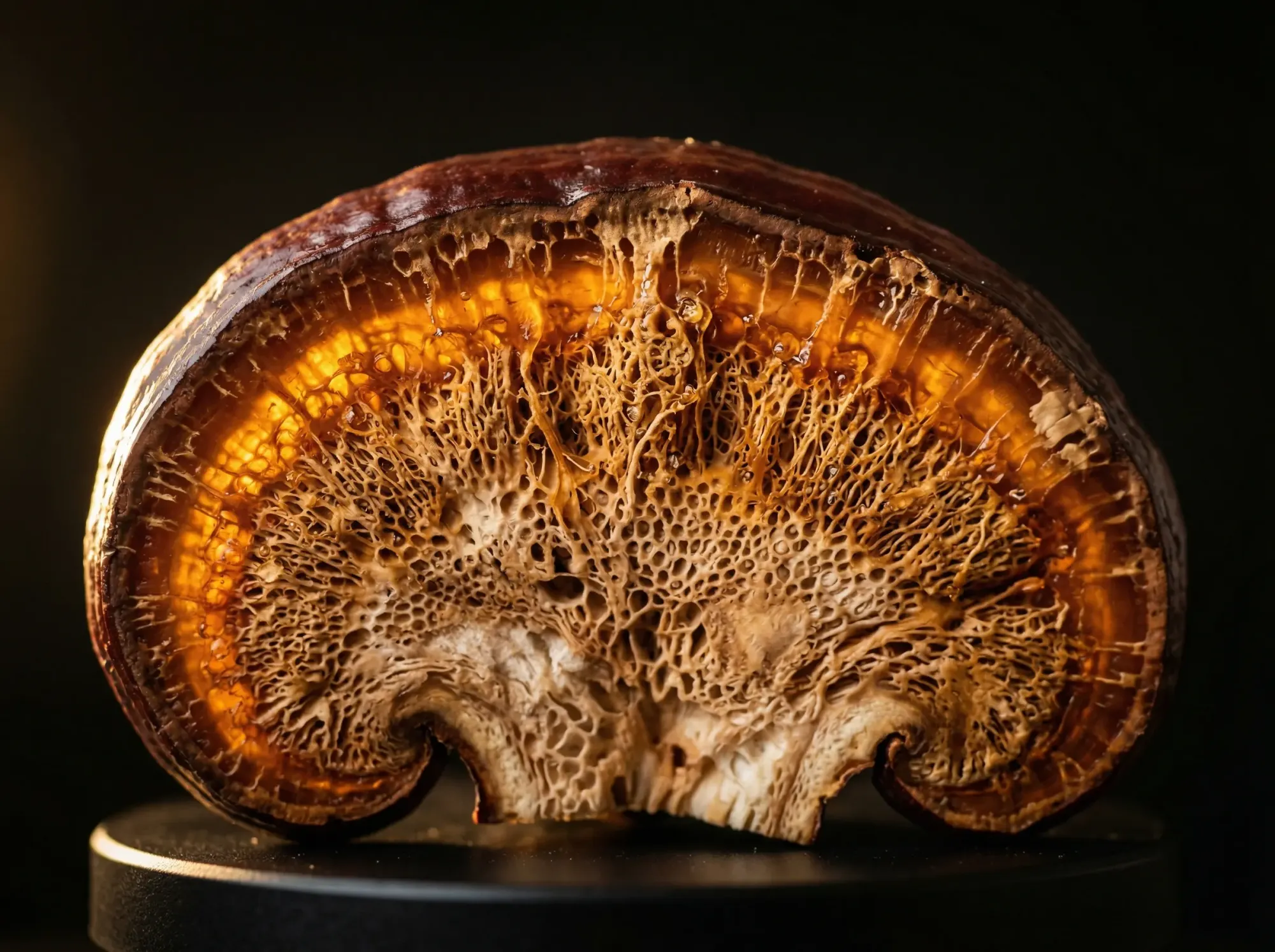
Encyclopedia of the Black Antler Morphology in Reishi (Ganoderma lucidum)
Variation in antler morphology is governed by triterpenoid concentration, carbon dioxide–mediated growth regulation, and the interplay between dormancy and physiological stress as outlined in the organism’s research profile.
Ganoderic Acid and the Source of Reishi’s Signature Bitterness
The characteristic bitterness of Reishi (Ganoderma lucidum) arises from its ganoderic acids, a family encompassing more than 150 distinct triterpenoid structures.
Triterpenes and the Molecular Foundations of Reishi's Bitterness
The characteristic bitterness of Reishi mushroom is a direct indication of its ganoderic acid concentration, which is widely regarded as a key marker of quality.
Reishi and Cordyceps: A Comparative Analysis of Adaptogenic Properties
Reishi and Cordyceps represent two distinct chemical identities: the triterpenoid-rich profile of Ganoderma lucidum contrasts with the nucleoside-dominated chemistry of Cordyceps species, yielding divergent frameworks of traditional use and sharply differing in vitro research landscapes.
Maitake versus Reishi: A Comparative Analysis of Beta-Glucan and Triterpene Profiles
The polysaccharide and triterpene profiles of Maitake (Grifola frondosa) and Reishi (Ganoderma lucidum) exhibit distinct chemotaxonomic signatures that underpin their divergent applications. Maitake’s hallmark β-glucan proteoglycan, the D-fraction, contrasts with Reishi’s array of ganoderic acids, a
NLRP3 Inflammasome Activation by Fungal Components: A Sterile Inflammation Framework
The NLRP3 inflammasome is an intracellular multiprotein complex central to innate immunity, assembled upon danger sensing to activate caspase-1 and drive the maturation of IL‑1β and IL‑18. Its canonical activation proceeds through a tightly regulated two‑step process: a priming signal (often via NF‑
The Comprehensive Encyclopedia of Antrodia camphorata (Niu-Chang-Chih)
The Taiwanese endemic polypore fungus *Antrodia camphorata* is distinguished by its narrow host range, the production of bioactive triterpenoids of the antrocin class, and significant progress in controlled cultivation techniques.