A Comparative Overview of Lentinan, PSK, and Beta-Glucan
— A QUICK NOTE —
You browse mushroom products. Everywhere you look, "beta-glucan" appears — on oat products, on Shiitake, on Turkey Tail.
Are they all the same?
No. Beta-glucan is not a single molecule; it is a category. Every member within this category has a distinct structure, mechanism, and target.
— BETA-GLUCAN — THE CATEGORY —
Beta-glucan is the collective name for long-chain polysaccharides formed by glucose units linked through beta bonds. It exists in oats. It exists in mushrooms. But structural differences change everything.
Oat beta-glucan: Beta-(1→3)/(1→4) linkages. Forms a viscous gel in the digestive tract. Its effects on cholesterol and blood glucose derive from this mechanism.
Mushroom beta-glucan: Beta-(1→3)/(1→6) linkages. A three-dimensional helical structure. It activates immune cells — macrophages, NK cells, T cells — via Peyer's patches in the gut.
Same name. Different chemistry. Different target.
Richest natural source: Sparassis crispa — 40–45% beta-glucan. The highest known concentration for this parameter in the fungal kingdom.
— LENTINAN — SHIITAKE'S SPECIALIZED FORM —
Lentinan differs from standard beta-glucan. It is a purified, high-molecular-weight beta-1,3-glucan isolated from the fruiting body of Shiitake (Lentinula edodes), folded into a triple helix conformation.
This triple helix structure functionally distinguishes it from other beta-glucans — the manner in which it interacts with immune receptors is distinct.
Historical significance: In 1969, Goro Chihara and his team isolated Lentinan. It entered the market in Japan as an injectable pharmaceutical preparation — one of the rare instances, alongside PSK, where a mushroom-derived compound received clinical approval.
Reference: Chihara, G. et al. (1969). Fractionation and purification of lentinan from Lentinus edodes. Cancer Research.
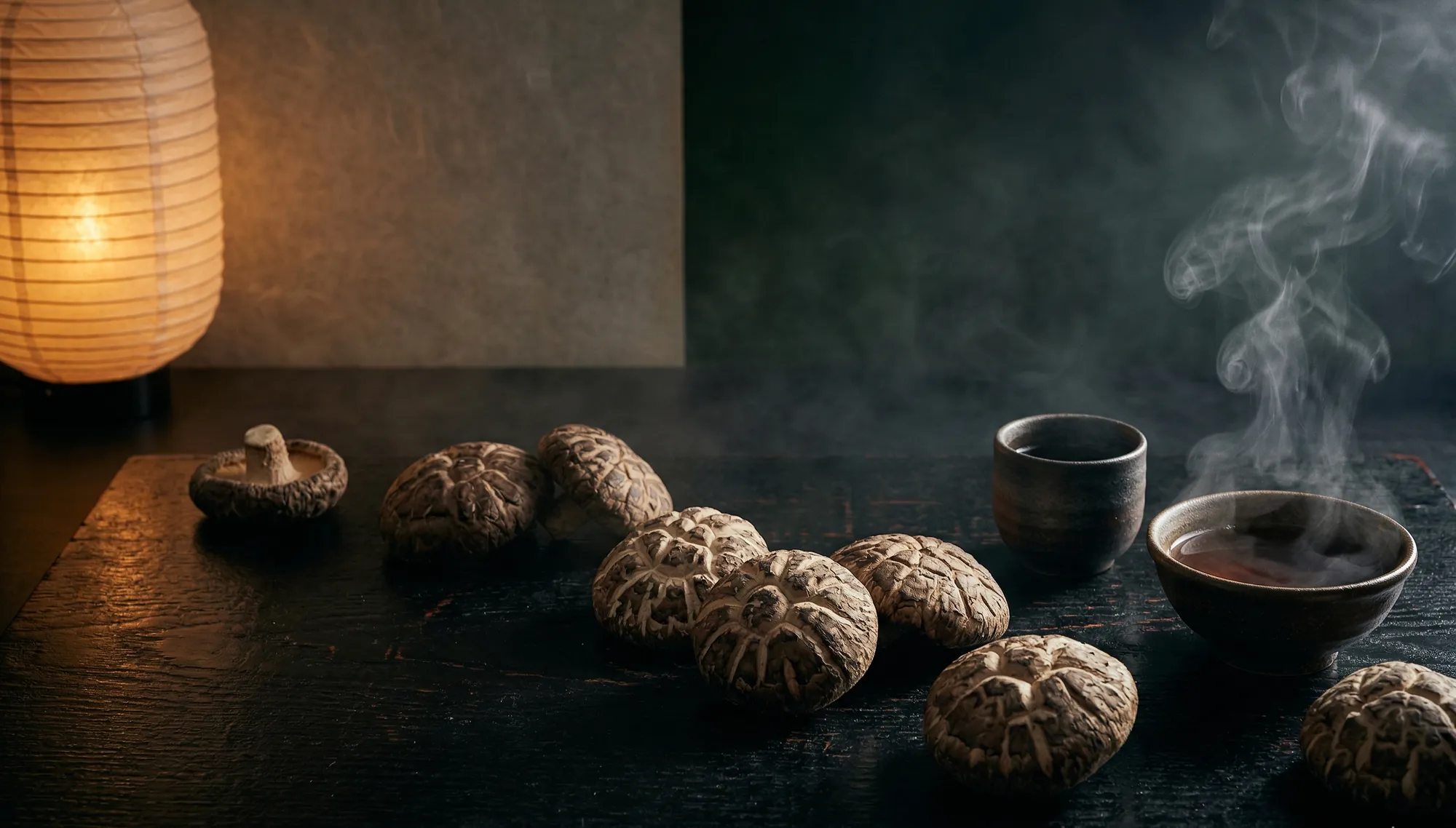
At MYCOVITA: Shiitake Donko — harvested before the cap opens, when Lentinan concentration peaks. Do not discard the soaking water — Lentinan is water-soluble and leaches into this liquid.
— PSK — THE PROTEIN-BOUND COMPLEX —
PSK (Polysaccharide-K) belongs to a structurally different category from Lentinan. It is not merely a polysaccharide — it is a protein-bound complex. A beta-(1→4) glucosidic main chain with branches, covalently bonded to a protein.
This protein linkage functionally separates PSK from Lentinan:
- A different survival profile in the digestive tract
- A distinct signaling pathway via Toll-like receptors (TLR2, TLR4)
- A long-term modulatory effect
Approval: In 1977, Japan's Ministry of Health approved PSK as a cancer adjuvant. It remains in standard protocols today.
Extraction is critical: PSK is a large molecule trapped inside the chitin wall. Brewing at 85–90°C for 10–12 minutes is essential — below this threshold, a substantial portion remains unextracted.
At MYCOVITA: Turkey Tail Apothecary No.05. PSK + PSP fractions. Designed for long-term daily use.
— SIDE-BY-SIDE COMPARISON —
| Beta-Glucan (Sparassis) | Lentinan (Shiitake) | PSK (Turkey Tail) | |
|---|---|---|---|
| Structure | Branched polysaccharide | Triple-helix beta-glucan | Protein-bound complex |
| Linkage type | β-1,3/1,6 | β-1,3 | β-1,4 + branches |
| Concentration | 40–45% (champion) | High; peaks in Donko | Low but specific |
| Mechanism | Peyer's patches → NK, macrophage | T-cell, macrophage balance | TLR2/TLR4 → NK, dendritic cell |
| Usage | Acute, high-dose | Culinary + functional | Long-term daily baseline |
| Brewing | 75–80°C, 5–8 min | Soaking water critical | 85–90°C, 10–12 min required |
— WHICH ONE, WHEN —
High-dose, acute beta-glucan loading: Sparassis — seasonal transitions, periods of intense stress. Use sparingly, achieve a strong result.
Culinary integration + immune support: Shiitake Donko — Lentinan on the plate and in the dashi.
Long-term systemic balance: Turkey Tail — daily baseline, consistent use throughout winter.
Combination strategy: Sparassis + Turkey Tail — two distinct fractions, two distinct mechanisms, working in concert.
— CAUTION —
These three compounds are potent immunomodulators. Individuals on immunosuppressive medications, those undergoing treatment for autoimmune conditions, and patients receiving chemotherapy or radiotherapy should consult their physician.
You May Also Find Interesting
→ Mushroom Science Glossary — 130+ Terms from A to Z
→ Can You Trust Mushrooms Cultivated in Turkey?
→ Functional Mushroom Production in Turkey
Related reading: What Is Lentinan? · What Is PSK? · What Is Beta-Glucan?
MYCOVITA's production philosophy and transparency principles: Why MYCOVITA?
Mycelial Library | MYCOVITA
Beta-Glucan and Immunomodulation — Related Resources
A content cluster on mushroom beta-glucan and immune system interaction:
- What Is Beta-Glucan? — Molecular structure and linkage types.
- How the Immune System Works — The Dectin-1 receptor and innate immunity.
- Beta-Glucan Measurement Methods — Megazyme and other laboratory techniques.
- Lentinan — Shiitake's clinically approved beta-glucan.
- PSK — Turkey Tail's polysaccharide-protein complex.
- D-Fraction — Maitake's active beta-glucan fraction.
- Lentinan vs PSK vs Beta-Glucan — A comparative guide.
- Sparassis crispa — The highest natural beta-glucan density.
- Chitin — The cell wall that traps beta-glucan.
- Extraction Methods — Beta-glucan bioavailability.
This content is for informational purposes only and does not constitute medical advice. Consult your physician before making any health-related decisions. Functional mushrooms are not pharmaceutical drugs and cannot be used to treat disease.
Version: 1.0 | Last updated: 20 Apr 2026 | Sources reviewed: 10+ | Method: Editorial Policy | References: Bibliography